
Appearance
Long-Term Considerations
TRT isn't a short-term fix - it's typically a lifelong commitment. Understanding what that means over the years and decades is important before you start.
The Lifelong Commitment
Let's be clear: once you start TRT, you'll likely be on it for life.
Why? Because:
- Your natural production shuts down while on TRT
- Coming off TRT means going through a hormonal recovery that may take months
- Recovery to pre-TRT levels isn't guaranteed
- Many men feel significantly worse when they stop
This isn't meant to scare you away from TRT if you need it. It's meant to ensure you're making an informed decision.
What Happens If You Stop TRT?
The typical experience stopping TRT:
| Timeframe | What Happens |
|---|---|
| Week 1-2 | Still feeling effects of testosterone in system |
| Week 2-4 | Levels dropping, starting to feel worse |
| Week 4-8 | Low testosterone symptoms, often worse than before starting |
| Month 2-4 | LH/FSH slowly returning, natural production may restart |
| Month 4-12 | Gradual recovery for most men |
| 12+ months | Some men still haven't fully recovered |
Think of it like pushing a car downhill. While you're pushing (on TRT), it moves easily. When you stop pushing, it doesn't just stop - it rolls backward. Getting it back to where it was requires a lot of effort and time.
Factors Affecting Recovery
- Age: Younger men tend to recover better
- Duration of TRT: Longer use may mean slower recovery
- Pre-TRT levels: If they were already very low, recovery may be limited
- Use of HCG: If used throughout TRT, may improve recovery
- Individual variation: Some recover well; others don't
If you're planning to stop TRT, do so under medical supervision.
A PCT (post-cycle therapy) protocol using HCG, Clomid, or both can help stimulate recovery. Going cold turkey is harder than a managed discontinuation. See Chapter 11: Fertility & TRT for details on HCG and recovery protocols.
Aging on TRT
Stable Levels Over Time
Men on TRT maintain consistent testosterone levels as they age, rather than experiencing the decline seen in population averages.
Important context: The "natural decline" often cited in statistics may be misleading. Research suggests that healthy, lean, active older men often maintain testosterone levels similar to younger men. The population-wide decline appears largely driven by the accumulation of health problems (obesity, chronic disease, medications) rather than aging itself.
So the comparison isn't necessarily "TRT user vs. declining natural male" - it may be "TRT user vs. healthy natural male who also maintains good levels."
That said, TRT does ensure consistent levels regardless of other health factors, which may help preserve:
- Muscle mass and strength
- Bone density
- Cognitive function
- Energy and vitality
- Sexual function
The Unknown
We don't have great long-term data on lifelong TRT.
TRT as a common treatment is relatively new. We have decades of experience with testosterone in various forms, but we don't have 40-year studies following men who started TRT at 35 and continued until 75.
What we know:
- Low testosterone is bad for health
- Normal testosterone appears protective
- Proper monitoring catches problems early
What we don't know with certainty:
- Whether TRT fully replicates the benefits of natural testosterone production
- Very long-term effects across the lifespan
- Whether the risks we monitor (hematocrit, etc.) have different implications over decades
Managing TRT as You Age
As you get older on TRT, you may need:
- Lower doses (sensitivity changes, less activity, different needs)
- More attention to hematocrit (tends to be stickier issue with age)
- More cardiovascular monitoring
- Prostate monitoring (PSA, possibly periodic exams)
- Bone density monitoring (ensure it's being maintained)
Cost Considerations
TRT is a lifelong expense. Let's be real about costs:
Rough cost estimates (US, without insurance):
| Item | Monthly Cost Range |
|---|---|
| Testosterone (generic cypionate) | $20-50 |
| Syringes/needles | $5-15 |
| HCG (if used) | $50-150 |
| Blood work (every 6-12 months) | $50-200 per panel |
| Doctor visits | $100-300 per visit |
| TRT clinic (all-inclusive) | $150-400/month |
Insurance may cover some or all of these
Generic testosterone cypionate from a regular pharmacy is cheap. The expensive part is often:
- TRT clinics with premium pricing
- Frequent blood work
- Add-ons like HCG, peptides, etc.
If cost is a concern, work with a regular doctor who can prescribe generic testosterone and do blood work through standard channels. You don't need a fancy clinic.
Access and Medical Supervision
Maintaining Access
Things to consider for long-term access:
- Have a regular doctor relationship - Don't rely solely on telemedicine clinics that could change policies or close
- Keep prescription records - Document your history
- Understand alternatives - If your clinic closes, know how to transition care
- Travel considerations - Know how to travel with testosterone (it's a controlled substance)
- Insurance changes - What if your coverage changes?
The Travel Issue
Traveling with testosterone:
- Keep it in original prescription packaging
- Carry a copy of your prescription
- For international travel, check country-specific regulations
- Consider timing injections around travel (or using daily gels temporarily)
Most domestic travel is fine with a prescription. International travel can be complicated - some countries consider testosterone a controlled substance.
Psychological Considerations
Dependency Awareness
You will become physiologically dependent on TRT. This isn't the same as addiction, but it's a form of dependency you should be aware of:
- You need regular access to medication
- Missing doses has consequences
- You can't just decide to stop without a plan
Some men find this liberating (consistent, reliable hormones). Others find it concerning (tied to medication forever). Neither reaction is wrong.
Long-Term Mindset
Successful long-term TRT requires:
- Accepting it as a permanent aspect of life (like wearing glasses or taking thyroid medication)
- Staying engaged with monitoring (not becoming complacent)
- Adjusting protocols as needed over time
- Working with competent medical providers
When to Reassess
Periodically, it's worth asking:
- Is my current protocol still optimal?
- Have my goals or needs changed?
- Am I experiencing any concerning side effects?
- Has new research changed best practices?
- Am I still working with a knowledgeable provider?
Potential Future Considerations
If You Develop a Medical Condition
Some conditions may require adjusting or stopping TRT:
- Certain cardiovascular events (may require evaluation)
- Prostate cancer diagnosis (controversial - seek expert opinion)
- Polycythemia vera (true blood cancer, different from TRT-induced high hematocrit)
- Liver disease (may affect hormone metabolism)
If Research Changes Recommendations
The medical understanding of TRT continues to evolve. Stay informed about:
- New long-term safety data
- Changes in recommended monitoring
- Improved treatment options or delivery methods
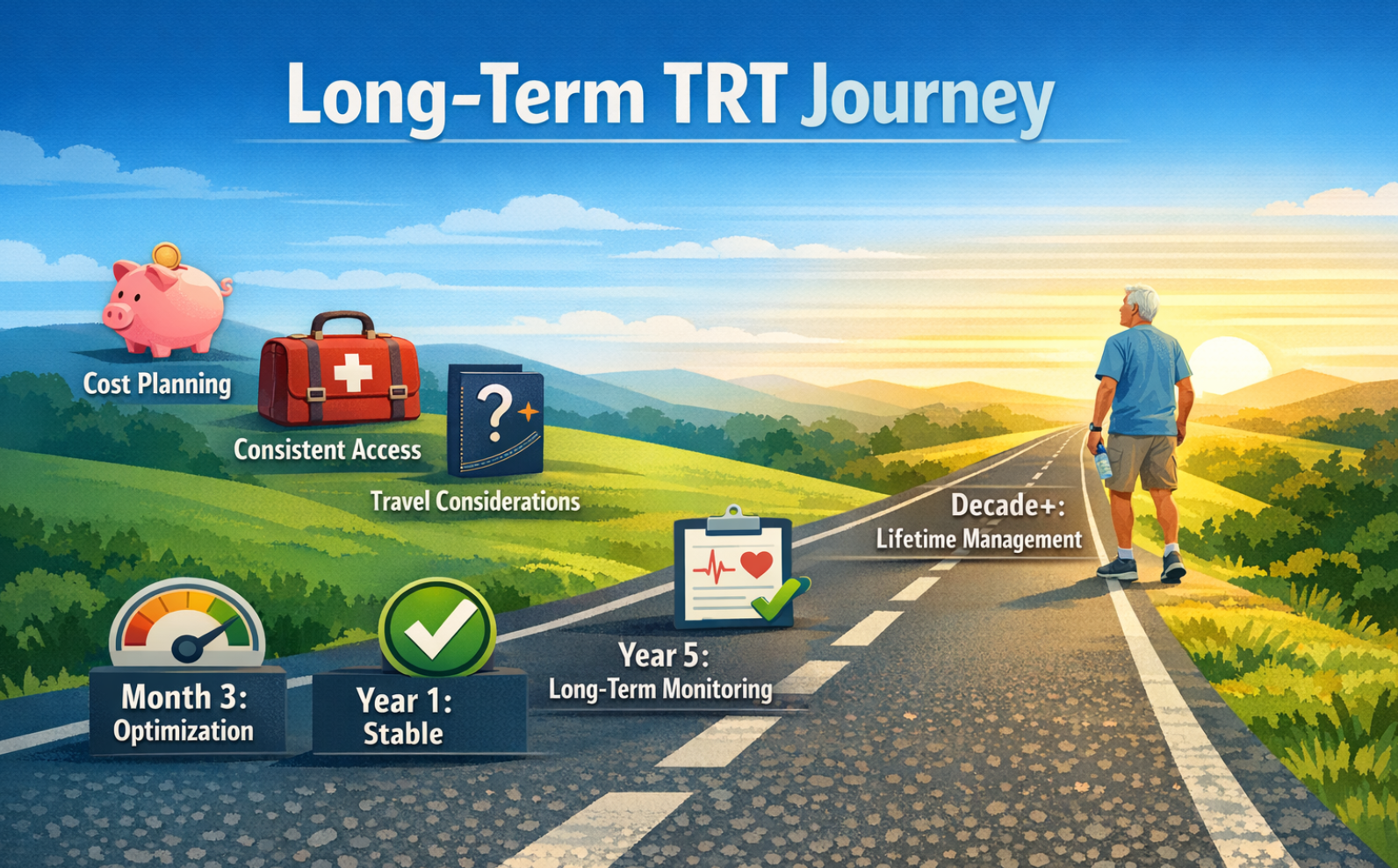
Quick Recap
The Reality
- TRT is typically lifelong
- Stopping is possible but difficult
- Recovery of natural production varies
Aging on TRT
- Maintains consistent testosterone levels
- May help preserve muscle, bone, cognition
- Note: Healthy men often maintain good levels naturally too
- Long-term data still being collected
Practical Matters
- Budget for ongoing costs
- Maintain medical relationships
- Plan for access issues
- Stay engaged with monitoring
Mindset
- Accept it as permanent
- Stay informed and adaptable
- Don't become complacent about health
Next up: Myths & Misconceptions - Debunking the most common (and dangerous) myths about TRT.