
Appearance
TRT & Exercise
Let's talk about what everyone wants to know: will TRT make you jacked? The answer is more nuanced than the marketing would have you believe.
Setting Realistic Expectations
TRT is not a magic muscle-building drug.
At TRT doses (aiming for normal physiological levels), you won't experience the dramatic muscle gains that come with supraphysiological steroid cycles. That's not what TRT is for.
If you're expecting to start TRT and suddenly look like a bodybuilder, you're going to be disappointed. TRT restores normal hormone levels - it doesn't give you superhuman hormones.
That said, if you genuinely had low testosterone, TRT can make a meaningful difference. Just not a miraculous one.
What TRT Actually Does for Training
The Recovery Advantage
This is the real benefit: recovery.
Testosterone doesn't magically build muscle by itself. What it does is:
- Improve protein synthesis (how well your body repairs and builds muscle)
- Reduce muscle breakdown (catabolism)
- Speed recovery between workouts
- Allow you to tolerate more training volume
Think of TRT like getting better sleep for your muscles. The workout is still the stimulus that tells your body to grow. But with adequate testosterone, your body is better at responding to that stimulus and repairing the damage.
Someone training 4x per week with good testosterone will recover faster than someone training 4x per week with low testosterone. The person with good testosterone can potentially train 5x per week, or train harder, because they recover better.
Over months and years, this adds up.
What You Might Experience
| Timeframe | What to Expect |
|---|---|
| Week 1-4 | Maybe slightly better gym "pumps," possibly improved motivation |
| Week 4-8 | Noticeably better recovery, less soreness |
| Week 8-16 | Strength improvements, body composition starting to change |
| Month 4-6 | Visible muscle improvement (if training properly) |
| Month 6-12 | More significant body recomposition |
| Year 1+ | Continued steady progress with proper training |
The "Initial Phase" Phenomenon
Many men notice a more dramatic response in the first few months of TRT, with rapid strength gains and noticeable body composition changes. Then it seems to plateau.
This isn't TRT "stopping working." It's your body rapidly recovering from the depleted state caused by low testosterone. Once you've recovered what you were missing, further gains require actual training stimulus, just like anyone else.
Think of it like filling a bucket that had a hole in it:
- Before TRT: Bucket leaking (muscle loss, poor recovery)
- Start TRT: Hole gets plugged, bucket starts filling fast
- Months later: Bucket is full; now you're maintaining and slowly adding
TRT vs. Natural: The Pattern Difference
Here's something subtle but worth understanding:
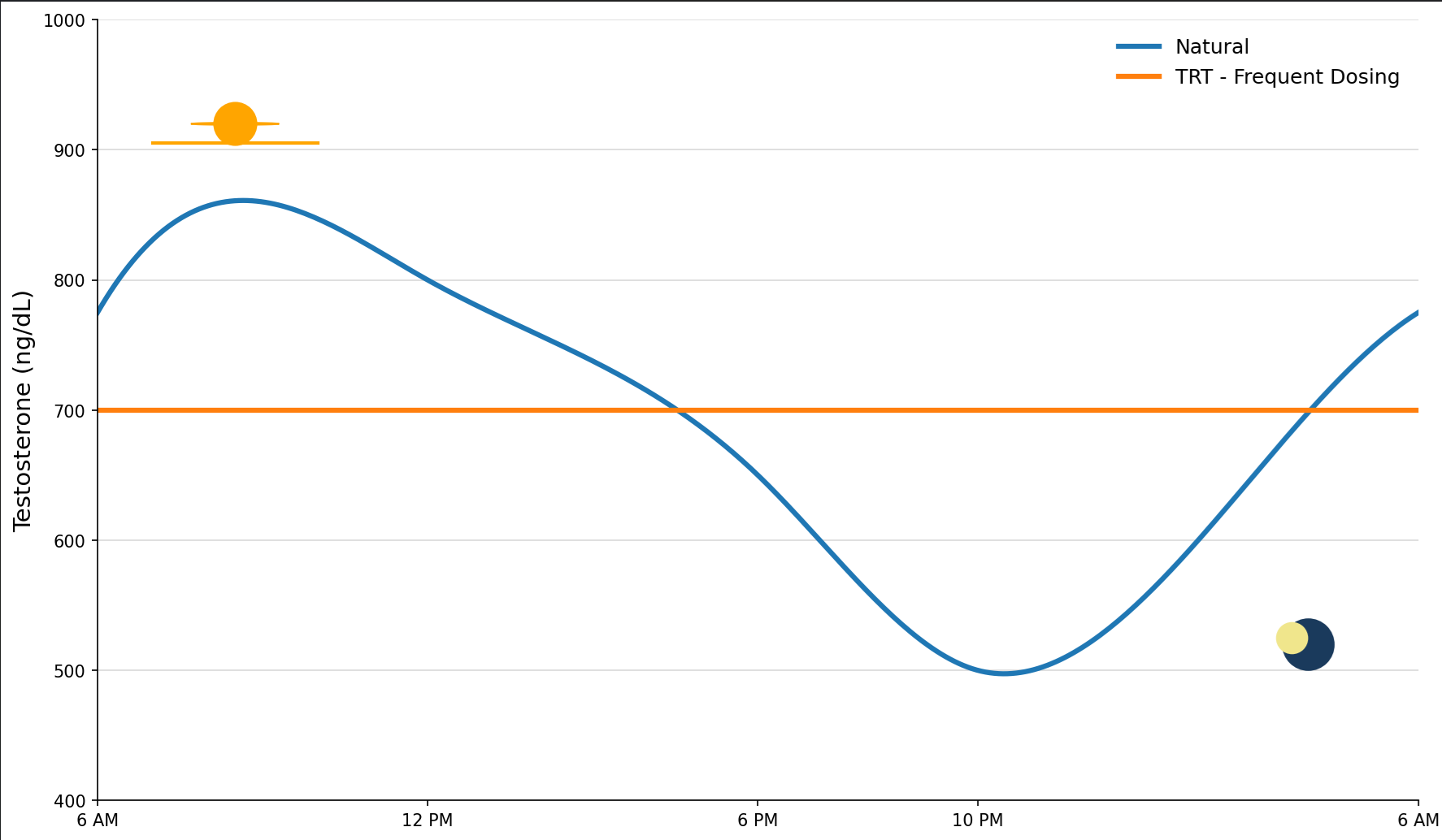
Natural testosterone follows a daily rhythm - highest in the morning, declining through the day.
A natural man with an average testosterone of 700 ng/dL actually experiences:
- Morning peak: ~850-900 ng/dL
- Evening trough: ~500-550 ng/dL
A man on well-managed TRT (frequent injections) has more stable levels throughout the day - perhaps 650-750 ng/dL with smaller fluctuations.
Area Under the Curve
For anabolic effects (muscle building, recovery, body composition), what matters most is the area under the curve - your total testosterone exposure over time. A man with stable 700 ng/dL all day gets similar anabolic benefits to a man who peaks at 900 and drops to 500, because the total exposure is comparable.
Why Stable Levels Are Better for Side Effects
For side effects, however, stable levels are actually superior. Here's why:
Aromatase activity is not linear.
When testosterone spikes, aromatase (the enzyme that converts testosterone to estradiol) doesn't respond proportionally - it can cause exaggerated conversion to estradiol during peaks. The same applies to 5-alpha reductase and DHT conversion.
This means:
- A man with big peaks and troughs may convert more testosterone to estradiol overall
- Stable levels result in more predictable, manageable estradiol
- Fewer spikes = fewer side effects at the same average testosterone level
This is why frequent dosing is so important. You get the same anabolic benefit (same area under the curve) with a better side effect profile (stable levels, less exaggerated conversion).
| Comparison | Morning | Evening | Pattern |
|---|---|---|---|
| Natural at 700 avg | ~900 ng/dL | ~500 ng/dL | High peak, significant drop |
| TRT (frequent dosing) | ~700 ng/dL | ~700 ng/dL | Stable throughout |
Training Considerations on TRT
You Still Have to Train
TRT without training does very little for muscle mass.
Studies show that supraphysiological testosterone (steroids, not TRT) can build some muscle without training. But at TRT doses, the effect without exercise is minimal.
You have to actually lift weights, follow a program, and progressively overload. TRT just helps you respond better to that training.
Volume Tolerance
On TRT, you may be able to handle more training volume than before:
- More sets per muscle group
- More training frequency
- Faster recovery between sessions
But start conservative and add volume gradually. You can always add more later.
Don't Overtrain Just Because You Recover Faster
Some guys get TRT and suddenly think they need to train 6 days a week for 2 hours. This usually leads to:
- Overuse injuries
- Burnout
- Actually worse results
TRT improves recovery, but you still need recovery. The answer isn't maximum volume; it's optimal volume.
Your tendons don't adapt as fast as your muscles. TRT helps muscles recover and grow faster, but tendons and connective tissue adapt much more slowly - they have less blood supply and lower metabolic activity.
If you ramp up training too quickly because your muscles can handle it, you risk developing tendinopathies (tennis elbow, patellar tendinitis, rotator cuff issues, etc.). These injuries can sideline you for months. Progress gradually and listen to joint/tendon pain - it's often a warning sign.
Fat Loss
TRT can help with fat loss, but indirectly:
| Mechanism | How It Helps |
|---|---|
| Increased metabolism | Muscle is metabolically active |
| Better workout quality | Burn more calories training |
| Improved motivation | Actually go to the gym |
| Body composition shift | More muscle, relatively less fat |
TRT won't magically melt fat while you sit on the couch eating pizza. But combined with proper training and nutrition, it supports the body composition improvements you're working toward.
If you're significantly overweight, losing fat should be a priority alongside TRT. The synergy works both ways - TRT helps you train better to lose fat, and losing fat helps TRT work better (less aromatization, better SHBG).
Realistic Body Composition Changes
What can you realistically expect in the first year of TRT with consistent training?
Ballpark estimates for a committed trainee:
| Measure | Realistic Expectation |
|---|---|
| Muscle gain | 5-10 lbs of lean mass |
| Fat loss | 5-15 lbs (with diet) |
| Strength increase | 10-25% on major lifts |
| Visual change | Noticeable but not dramatic |
These assume consistent training, adequate nutrition, and starting from a low-testosterone baseline.
These numbers aren't that different from what a natural lifter with normal testosterone might achieve in a good year. The advantage of TRT is that you can sustain this progress more consistently, and you're not fighting against a hormonal handicap.
If someone tells you TRT alone gave them 30 lbs of muscle in 6 months, they're either lying, they were on much more than TRT, or they're counting water weight.
The "Sports TRT" Concept
A note on clinic dosing:
Many TRT clinics prescribe 200mg/week as a standard starting dose. For most men, this puts testosterone levels significantly above the normal range - often 1200-1500+ ng/dL.
This isn't really TRT. It's a low-dose steroid cycle marketed as TRT. Some call it "sports TRT."
While you'll build more muscle at these supraphysiological levels, you're also taking on more health risks. True replacement therapy aims for normal levels, not maximum levels.
Cardio and TRT
TRT can affect cardiovascular performance:
Potential Benefits
- More red blood cells (better oxygen delivery)
- Better recovery between cardio sessions
- Improved body composition reduces cardiovascular strain
Potential Concerns
- Hematocrit increase (see Chapter 14)
- Blood pressure changes
- Need to monitor cardiovascular markers
Include some cardiovascular training in your routine. It helps manage hematocrit, blood pressure, and overall health markers - all things that need attention on TRT.
Quick Recap
What TRT Does
- Improves recovery between workouts
- Allows better training volume tolerance
- Supports muscle protein synthesis
- Provides more stable hormone levels throughout the day
What TRT Doesn't Do
- Magically build muscle without training
- Turn you into a bodybuilder
- Replace the need for proper programming
- Work if you don't put in the effort
Realistic Expectations
- 5-10 lbs lean mass gain in first year (with training)
- Better strength progression
- Improved body composition
- Subtle but meaningful improvements
Warning
- 200mg/week is often supraphysiological, not true TRT
- More isn't always better
- Health markers matter more than maximum gains
Next up: Monitoring on TRT - What to watch, how often to test, and red flags to look for.