
Appearance
Estrogen Management
This is one of the most misunderstood topics in TRT. There's a lot of fear about estrogen in men, and that fear leads to overtreatment that often makes things worse.
Let's set the record straight.
Estrogen in Men: Not the Enemy
Estrogen is not your enemy. You need it.
Estrogen (primarily estradiol, or E2) is essential for male health. It's not just a "female hormone" - it plays critical roles in men too.
What Estradiol Does for Men
| Function | Why It Matters |
|---|---|
| Bone health | Estradiol is MORE important than testosterone for male bone density |
| Cardiovascular health | Protects blood vessels, regulates cholesterol |
| Brain function | Mood, cognition, neuroprotection |
| Libido | Yes, you need estradiol for sex drive |
| Joint health | Lubricates and maintains joint tissue |
| Fat metabolism | Influences body composition |
Men with estradiol that's too LOW often feel just as bad as men with estradiol that's too high - sometimes worse. The goal is balance, not elimination.
How Testosterone Becomes Estradiol
Some of your testosterone gets converted into estradiol by an enzyme called aromatase. This process is called aromatization.
Think of aromatase as a machine that takes testosterone and converts it into estradiol. This machine runs more actively in certain tissues and under certain conditions.
Where Aromatization Happens
- Fat tissue (this is the big one)
- Liver
- Brain
- Bone
- Testes
The fat connection is crucial:
The more body fat you have, the more aromatase activity you have. This is why obese men often have elevated estradiol relative to their testosterone.
Losing body fat naturally reduces aromatization and improves your testosterone-to-estradiol ratio better than any drug.
What's a "Normal" Estradiol Level?
General reference ranges for men:
| Level | Interpretation |
|---|---|
| <20 pg/mL | Too low - causes bone loss, joint pain, mood issues |
| 20-40 pg/mL | Good range for most men |
| 40-50 pg/mL | Upper range - often fine if no symptoms |
| >50 pg/mL | Can cause symptoms, but not bad if you feel fine |
These are guidelines, not absolute rules. Individual optimal ranges vary.
Important testing note:
Always request the sensitive estradiol assay (LC/MS-MS) for men. The standard estradiol test is designed for women's higher levels and is inaccurate for male ranges.
If your lab result says "estradiol" without specifying "sensitive" or "LC/MS," it may not be accurate.
Symptoms of High vs. Low Estradiol
Both extremes cause problems:
| High E2 Symptoms | Low E2 Symptoms |
|---|---|
| Water retention, bloating | Joint pain, stiffness |
| Nipple sensitivity/gynecomastia | Dry, cracking joints |
| Mood swings, emotionality | Low libido |
| Decreased libido | Erectile dysfunction |
| Difficulty with erections | Depression, flat mood |
| Elevated blood pressure | Fatigue |
| Bone loss over time |
Notice how several symptoms (low libido, ED) appear on BOTH lists? This is why "just lower the estradiol" is often wrong. You might be crashing something that was already fine, making things worse.
Symptoms matter more than numbers. If your estradiol is 50 pg/mL but you feel great with no symptoms, you probably don't need to do anything about it.
Aromatase Inhibitors (AIs)
AIs are drugs that block the aromatase enzyme, reducing conversion of testosterone to estradiol.
AIs were developed for breast cancer treatment in postmenopausal women. Breast cancer cells often need estrogen to grow, so blocking estrogen production helps fight the disease. Using these powerful cancer drugs in healthy men to tweak hormone levels is an off-label use - and one that should be approached with caution.
Common AIs
- Anastrozole (Arimidex): Most commonly prescribed, typical TRT dose 0.125-0.25mg 1-2x/week
- Exemestane (Aromasin): Steroidal AI, sometimes preferred
- Letrozole (Femara): Most powerful, usually too strong for TRT
Here's the controversial truth: most men on TRT do NOT need an AI.
AIs are massively overprescribed by TRT clinics. They're handed out like candy, often before any symptoms even develop.
Why AIs Are Often Unnecessary
- Estradiol rises with testosterone - This is normal and expected
- High estradiol without symptoms isn't a problem - It's only an issue if you have symptoms
- More frequent injections reduce estradiol spikes - Better protocol = less need for drugs
- Lower TRT dose = lower estradiol - Often the dose is just too high
- Losing body fat reduces aromatization - Address the root cause
Many TRT clinics start everyone on an AI from day one. This is not good practice. It's treating a problem before it exists, and often creates NEW problems by crashing estradiol.
When AIs Might Actually Be Needed
AIs MAY be appropriate if you have:
- Confirmed high estradiol (sensitive assay)
- Actual symptoms of high estradiol (not just a number)
- Already optimized your protocol (frequent injections, appropriate dose)
- Already addressed body fat (if applicable)
- Tried without AI first and determined you need it
Risks of AI Overuse
Crashing estradiol is not fun:
- Severe joint pain (feels like arthritis)
- Depression and emotional flatness
- Loss of libido (yes, crashing E2 kills libido)
- Erectile dysfunction
- Fatigue and malaise
- Long-term: bone density loss, cardiovascular risk
Recovery from crashed estradiol typically takes days to weeks, depending on severity. Anastrozole has a long half-life (40-50 hours), so even after stopping, it keeps working for days. You'll feel terrible until levels rebuild - and in severe cases, full recovery can take weeks or even longer.
Better Approaches Than AIs
1. Optimize Injection Frequency
More frequent injections = smaller peaks = less aromatization = more stable estradiol. This is often the single most effective way to manage estradiol without drugs.
See Chapter 10: Injection Deep Dive for the full breakdown of why injection frequency matters and how to optimize it.
2. Lower the Dose
If your estradiol is high, your testosterone dose might just be too high. Lowering the dose proportionally reduces estradiol.
3. Lose Body Fat
Fat tissue is the primary site of aromatization. Less fat = less conversion = better ratio.
4. Time
Your body often adjusts over the first few months of TRT. Estradiol that seems high at week 6 may normalize by month 3-4.
If You Do Need an AI
If you've tried everything and genuinely need an AI:
Start extremely low, go slow:
- Begin with 0.125mg (half of a 0.25mg tablet) once weekly
- Even this tiny dose can crash estrogen in some men - AIs are potent
- Give it 4-6 weeks to assess effects
- Adjust based on symptoms AND labs
- Never chase a number - treat symptoms
- Consider using only as-needed, not continuously
Some men genuinely do aromatize heavily and need a small amount of AI. But this is the minority, not the majority. Most men on TRT don't need AIs if their protocol is dialed in properly.
The Ratio Myth
You might have heard about the "ideal testosterone to estradiol ratio" (often cited as 20:1 or similar).
There is no magic ratio.
This is bro-science that sounds scientific but isn't based on solid research. Individual variation is enormous. Some men feel great at a 15:1 ratio; others feel great at 30:1.
Focus on how you feel, not on hitting a specific ratio.
Managing Estradiol Without AIs: A Case Study
Scenario: Guy starts TRT at 200mg once weekly. Estradiol comes back at 60 pg/mL. Clinic says "here's an AI."
Better approach:
- First, lower dose to 140mg/week (often 200mg is too much anyway)
- Split into twice-weekly injections
- Retest in 6-8 weeks
- Result: Estradiol now 35 pg/mL, no AI needed
The problem wasn't "too much aromatization." The problem was "too much testosterone in too large a bolus."
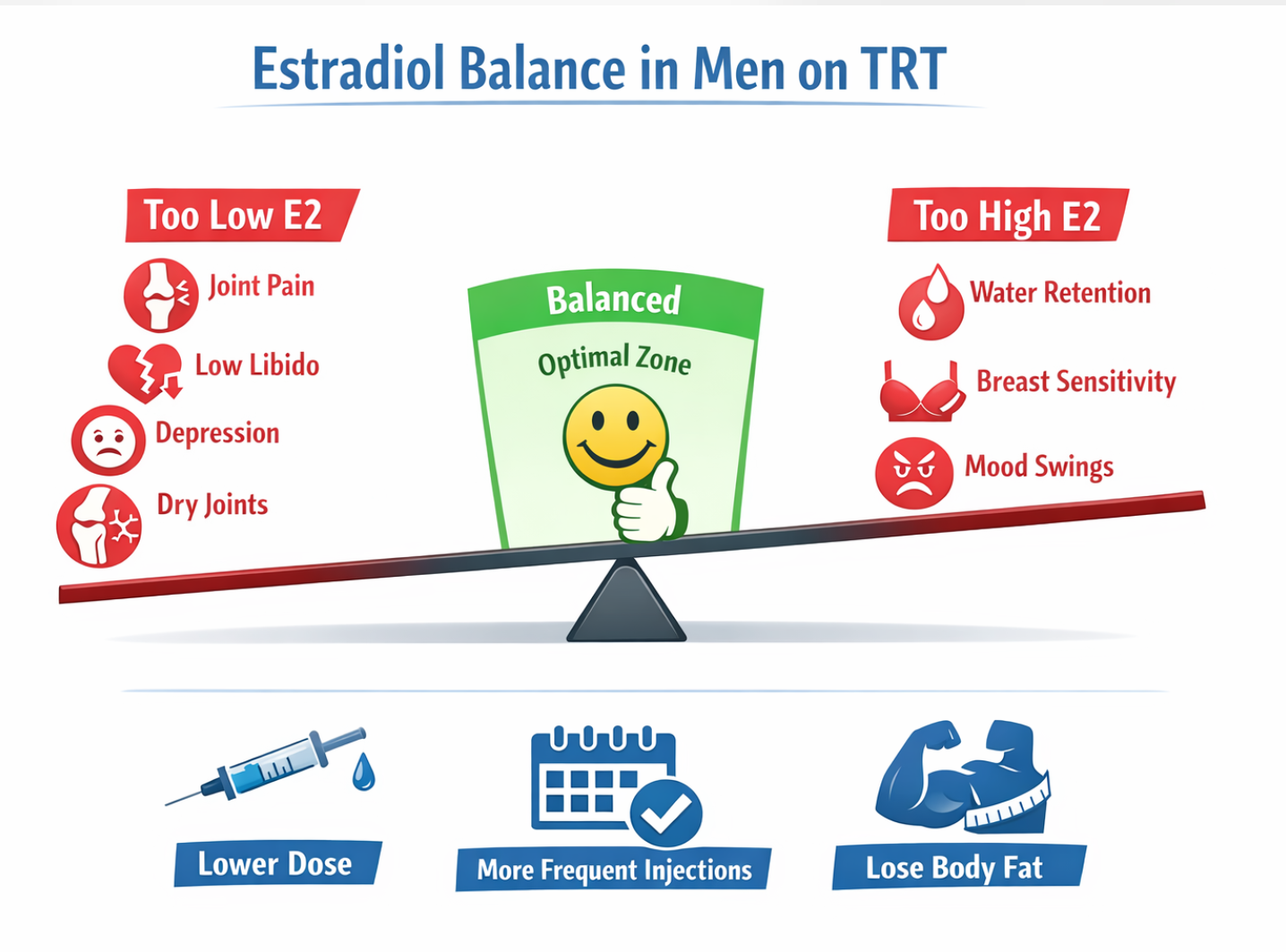
Quick Recap
Key Points
- Estradiol is essential for men, not the enemy
- Both too high AND too low cause problems
- Symptoms matter more than numbers
- Most men don't need AIs with proper protocols
Better Than AIs
- More frequent injections
- Lower testosterone dose
- Lose body fat
- Give it time
If You Need an AI
- Start with minimal dose
- Titrate slowly
- Don't chase numbers
- Treat symptoms, not labs
Warning Signs of Crashed E2
- Joint pain
- Depression
- Loss of libido
- Takes weeks to recover
Next up: TRT & Exercise - What TRT actually does (and doesn't do) for gym performance.