
Appearance
TRT Delivery Methods
So you need testosterone. How do you actually get it into your body? There are several options, each with distinct pros and cons. Most men end up on injections, but let's explore why that is and what else is available.
The Options at a Glance
| Method | Frequency | Pros | Cons |
|---|---|---|---|
| Injections | 1-3x per week | Effective, adjustable, cheap | Needles, some fluctuation |
| Gels/Creams | Daily | No needles, easy | Transfer risk, variable absorption |
| Patches | Daily | Steady levels | Skin irritation, may fall off |
| Pellets | Every 3-6 months | Infrequent dosing | Invasive, can't adjust, peaks/valleys |
| Nasal gel | 2-3x daily | Alternative route | Frequent dosing, nasal irritation |
Let's break each one down.
Testosterone Injections
The most common method, and for good reason.
How It Works
Testosterone is dissolved in an oil (usually cottonseed or sesame oil) and injected intramuscularly (IM) or subcutaneously (SubQ). The oil creates a depot from which testosterone slowly releases into your bloodstream.
Common Forms
- Testosterone Cypionate: Most common in the US
- Testosterone Enanthate: More common in Europe
These are essentially interchangeable - don't stress about which one you get. See Chapter 10: Injection Deep Dive for details on esters, half-lives, and why it doesn't matter much.
Pros
- Most effective: Reliable delivery directly into your system
- Adjustable: Easy to fine-tune dosing
- Cheap: Generic testosterone is inexpensive
- Proven: Decades of use, well-understood
- Stable levels: With frequent injections (more on this in Chapter 10)
Cons
- Needles: Some people hate them
- Learning curve: Need to learn injection technique
- Fluctuations: Peaks and troughs between injections (minimized with frequent dosing)
- Scar tissue: Possible with years of injections at the same sites
Most men who start with another method eventually switch to injections. They're simply the most reliable, adjustable, and cost-effective option.
The needle fear usually fades after the first few injections. Modern insulin syringes are tiny - we're not talking about big scary needles.
Testosterone Gels and Creams
A needle-free option that sounds appealing but has significant drawbacks.
How It Works
You apply testosterone gel or cream to your skin (usually shoulders, upper arms, or abdomen) daily. The testosterone absorbs through your skin and enters your bloodstream.
Common Forms
- AndroGel: Popular brand-name gel
- Testim: Another brand-name gel
- Compounded creams: Made by compounding pharmacies, often in higher concentrations
Pros
- No injections: Major selling point for needle-phobic folks
- Easy application: Just rub it on
- Daily dosing: Mimics natural daily rhythm somewhat
Cons
The transfer risk is real. Testosterone can transfer to partners, children, or pets who touch your skin. You must wait hours for absorption and wash hands carefully.
- Variable absorption: Some men don't absorb enough no matter what
- Higher DHT conversion: Topical application converts more testosterone to DHT (hair loss, prostate concerns)
- Daily application: Every single day without fail
- Cost: Usually much more expensive than injectable testosterone
- Messy: Gels can be sticky, creams can stain clothes
If your levels aren't adequate on gel, switching to injections usually solves the problem.
Testosterone Patches
Less common now, but still available.
How It Works
A patch containing testosterone is applied to the skin (usually arm, back, or abdomen) and releases testosterone continuously over 24 hours.
Common Forms
- Androderm: The main patch on the market
Pros
- Steady levels: 24-hour release provides stable testosterone
- No injections: Good for needle-averse
- Easy to use: Apply and forget
Cons
- Skin irritation: Many men develop rash or irritation at the application site
- Adhesion issues: Patches can fall off during sweating, bathing, or activity
- Limited dosing flexibility: Comes in set doses
- Visible: Can be seen if shirtless
- Cost: Generally expensive
Patches have largely fallen out of favor because the skin irritation issue affects a significant percentage of users. Many men develop allergic-type reactions that make continued use impossible.
Testosterone Pellets
Long-acting but problematic in several ways.
How It Works
Rice-sized testosterone pellets are implanted under the skin (usually in the buttocks or hip area) through a minor surgical procedure. They slowly dissolve over 3-6 months, releasing testosterone.
Common Forms
- Testopel: The main brand
Pros
- Infrequent dosing: Only need to do something every 3-6 months
- No daily effort: Once implanted, you don't think about it
- No transfer risk: Testosterone is under your skin
Cons
Major drawback: You can't adjust or remove them.
Once pellets are in, you're stuck with whatever level they provide until they dissolve. If the dose is too high or too low, there's nothing to do but wait months.
- Procedure required: Minor surgery with local anesthetic each time
- Infection risk: Any implantation carries infection risk
- Extrusion: Pellets can work their way out through the skin
- Level inconsistency: High levels initially, declining over time
- Expense: Procedure costs add up
The Peak/Trough Problem:
| Week | Testosterone Level |
|---|---|
| Week 1-2 | Very high (supraphysiological) |
| Week 4-8 | Optimal range |
| Week 10-14 | Declining |
| Week 14-18 | May be below optimal |
This sawtooth pattern is far less stable than well-managed injections.
Pellets are often marketed as "set it and forget it" convenience. The reality is they're less flexible and often less consistent than other options. Most men who switch from pellets to injections report better stability.
The inability to adjust dosing is a dealbreaker for many. With injections or gels, you can change your dose if bloodwork shows you're too high or low. With pellets, you're locked in for months.
Nasal Testosterone (Natesto)
A newer option with a unique delivery method.
How It Works
Testosterone gel is applied inside the nose using a special applicator. It absorbs through the nasal mucosa into the bloodstream.
Common Forms
- Natesto: The only FDA-approved nasal testosterone
Pros
- No transfer risk: Testosterone is inside your nose
- Preserves some fertility: May not suppress LH as completely as other methods
- No injections: Good for needle-averse
- Fast-acting: Rapid absorption
Cons
- Very frequent dosing: Must be applied 2-3 times daily
- Nasal irritation: Common side effect
- Runny nose/congestion: Some experience this
- Lower levels: May not achieve as high levels as injections
- Expensive: Brand-name only, no generic
Natesto's potential fertility preservation is interesting. Studies suggest it may not fully suppress LH/FSH like other forms, potentially maintaining some sperm production. However, it's not a guarantee of fertility preservation and levels achieved are often lower.
For most men, if you want fertility preservation, adding HCG to injectable TRT is a more reliable approach.
Why Most Men End Up on Injections
After all that, here's the reality:
Injections win for most men because they're:
- Most reliable - Guaranteed delivery, no absorption variables
- Most adjustable - Precise dose control
- Most cost-effective - Generic testosterone is cheap
- Most stable - With frequent dosing, levels stay consistent
- Most studied - Longest track record
The other methods exist because not everyone can or wants to inject. They have their place. But if you're starting TRT and don't have a strong reason to avoid needles, injections are typically the best choice.
Which Method is Right for You?
Consider these factors:
| Factor | Recommendation |
|---|---|
| Needle phobia | Start with gel, but be open to switching |
| Partner/child transfer concerns | Injections or pellets |
| Need for precise dosing | Injections |
| Lifestyle (frequent travel) | Pellets or auto-injectors |
| Cost sensitivity | Injections (generic) |
| Desire for stable levels | Frequent injections or patches |
| Fertility concerns | Consider nasal or add HCG to injections |
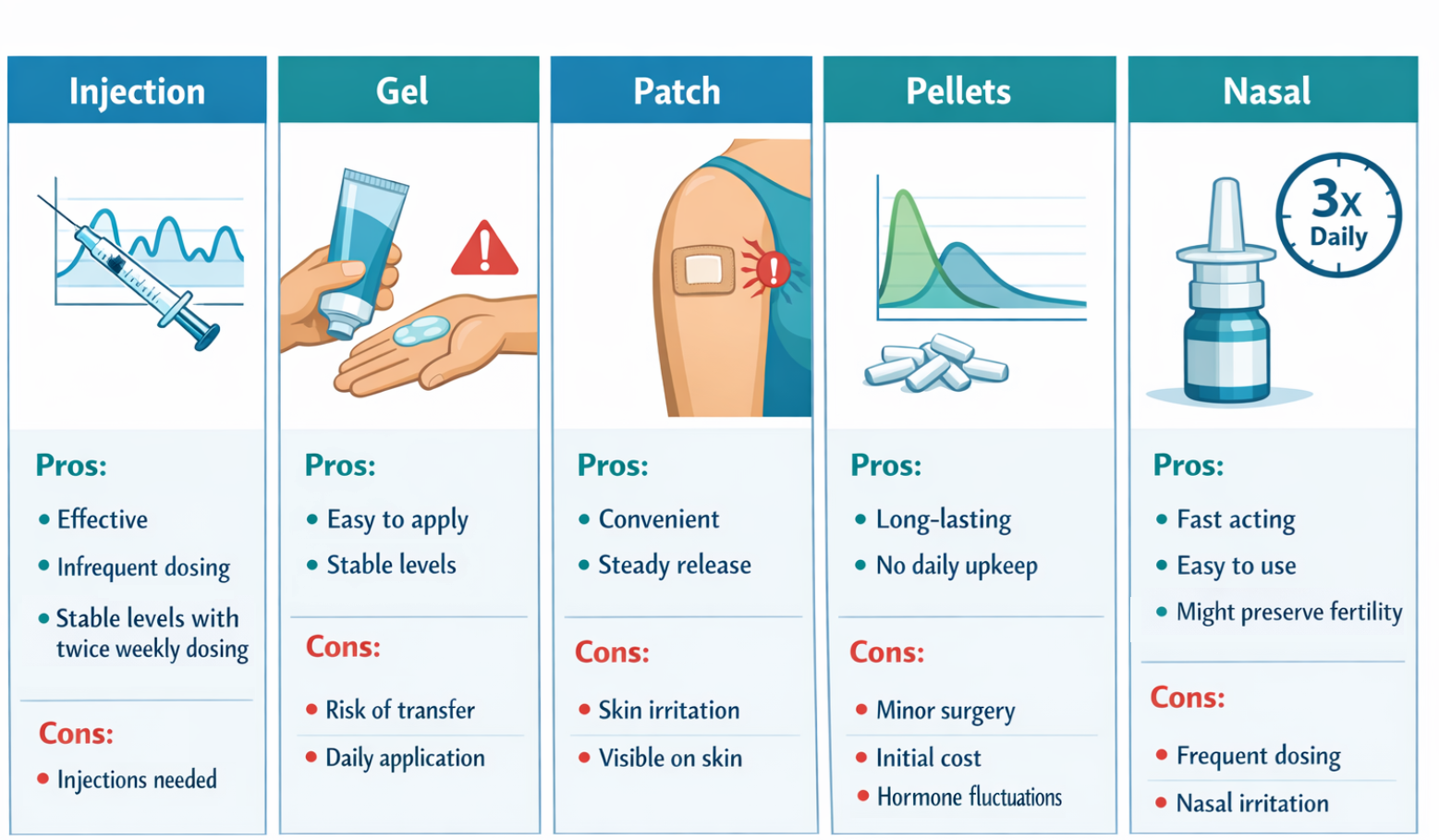
Quick Recap
Injections
- Most popular for good reason
- Reliable, adjustable, affordable
- Requires comfort with needles
Gels/Creams
- Convenient but less reliable
- Transfer risk to others
- Variable absorption, may increase DHT more
Patches
- Steady levels but often cause skin irritation
- Limited flexibility
Pellets
- Infrequent but inflexible
- Can't adjust once placed
- Peaks high, then declines
Nasal
- Unique option, may preserve some fertility
- Requires multiple daily applications
- Expensive
Next up: Injection Deep Dive - Since most men end up here, let's cover injection frequency, esters, techniques, and why more frequent injections are usually better.