
Appearance
What Affects Testosterone
The Big Players
1. Body Fat
Excess body fat is arguably the single biggest modifiable factor affecting testosterone in most men.
Here's why obesity kills testosterone:
- Fat tissue contains aromatase - the enzyme that converts testosterone to estradiol
- More fat = more conversion = higher estradiol
- High estradiol signals the brain to reduce LH production
- Reduced LH = reduced testosterone production
It's a vicious cycle: low testosterone makes it harder to lose fat, and more fat lowers testosterone further.
The Numbers:
- Obese men have testosterone levels approximately 30-40% lower than normal-weight men
- Each unit of BMI increase correlates with roughly 2% decrease in testosterone
- Losing significant weight can increase testosterone by 100-200 ng/dL in some men
2. Being Too Lean is Also Bad
Wait, what?
Extremely low body fat (below 8-10%) can also tank testosterone. Your body interprets severe caloric restriction and very low body fat as starvation conditions and starts shutting down "non-essential" functions - including reproduction.
This is why male fitness competitors often experience:
- Loss of libido
- Erectile dysfunction
- Mood crashes
- Feeling terrible
...during their lowest body fat phases. It's not just the dieting stress - it's a hormonal survival response.
The sweet spot for most men is probably somewhere between 12-20% body fat. Low enough to minimize excessive aromatization, but not so low that your body thinks you're starving.
3. Sleep
Poor sleep is a testosterone killer.
Most testosterone production happens during sleep, particularly during deep sleep. Chronic sleep deprivation directly suppresses the HPG axis.
Research findings:
- One week of restricted sleep (5 hours/night) reduced testosterone by 10-15%
- Sleep apnea is associated with significantly lower testosterone
- Testosterone peaks during REM sleep
Your body is like a smartphone. During the night (while charging/sleeping), it runs maintenance and updates. If you keep using it instead of letting it charge, things start to break down.
4. Stress and Cortisol
Cortisol (the stress hormone) and testosterone have an inverse relationship. When cortisol goes up chronically, testosterone tends to go down.
Chronic stress affects testosterone through multiple pathways:
- Direct suppression of the HPG axis
- Competition for the same precursor hormones
- Sleep disruption (see above)
- Behavioral changes (eating poorly, not exercising)
This is why some men with "lifestyle-induced" low testosterone might have testicles that can produce adequate testosterone, but their chronic stress is suppressing the system.
A firefighter, night-shift ER nurse, or first responder with an incredibly stressful lifestyle might have a body capable of producing good testosterone levels, but their lifestyle never allows it to happen.
For these individuals, TRT might be reasonable even if their hypogonadism is theoretically "reversible" - because their lifestyle isn't going to change.
5. Age
This one is more nuanced than most people think.
The conventional wisdom says testosterone declines 1-2% per year after 30. But research tells a more interesting story: studies of exceptionally healthy older men show minimal decline with age. One Australian study concluded that "age, in itself, has no effect on testosterone level in healthy older men."
The decline we see in population studies may be largely driven by the accumulation of health problems that come with age - obesity, metabolic syndrome, chronic disease, medications, poor sleep - rather than aging itself.
Many men maintain excellent testosterone levels into their 70s and 80s when they stay lean, active, and healthy.
That said, there are some age-related changes:
- Leydig cells become slightly less responsive to LH stimulation over time
- SHBG increases with age (meaning less free testosterone even if total stays stable)
But research suggests lifestyle and health factors may be just as important as chronological age in determining testosterone levels. The takeaway: don't assume low T is inevitable as you age.
Other Significant Factors
Vitamin D
Vitamin D deficiency is associated with lower testosterone. While supplementing vitamin D in men who are already sufficient probably won't boost testosterone, correcting a deficiency might help.
Target vitamin D level: 40-60 ng/mL is often considered optimal
Many people, especially those in northern climates or who work indoors, are deficient.
Alcohol
Moderate alcohol consumption probably isn't a big deal for testosterone.
However, heavy or chronic alcohol use:
- Directly suppresses testosterone production
- Damages Leydig cells over time
- Increases aromatase activity (more conversion to estrogen)
- Disrupts sleep quality
- Often leads to weight gain
Exercise
Exercise generally helps testosterone, but the type and amount matter:
| Exercise Type | Effect on Testosterone |
|---|---|
| Heavy resistance training | Acute increase, long-term positive |
| HIIT | Acute increase |
| Moderate cardio | Neutral to slightly positive |
| Extreme endurance training | Can lower testosterone |
Overtraining can suppress testosterone. Ultra-endurance athletes (marathon runners, ironman triathletes) often have lower testosterone due to the extreme physiological stress.
More isn't always better. Recovery matters.
Medications
Several medications can lower testosterone:
| Medication | Effect |
|---|---|
| Opioids | Strongly suppress LH and testosterone |
| Glucocorticoids (prednisone, etc.) | Suppress HPG axis |
| Antidepressants (some) | May affect testosterone or sexual function |
| 5-alpha reductase inhibitors (finasteride) | Lower DHT, may affect sexual function |
| Spironolactone | Anti-androgen effects |
| Statins | Possibly modest effect (controversial) |
| Prior anabolic steroid use | Can cause long-term suppression |
Medical Conditions
Various health conditions affect testosterone:
- Diabetes / Insulin Resistance: Strongly associated with low testosterone
- Sleep Apnea: Treat this and testosterone often improves
- Thyroid Disorders: Can affect testosterone metabolism
- Chronic Kidney Disease: Associated with low testosterone
- Liver Disease: Affects SHBG and hormone metabolism
- HIV/AIDS: Can affect hormone production
- Chronic Pain: Both the condition and opioid treatment lower testosterone
The Diagnostic Approach: HCG Trial
Before committing to lifelong TRT, especially in younger men or those with secondary hypogonadism, some doctors try an HCG trial - taking HCG for 6-8 weeks to see if your testicles can respond. If testosterone normalizes, the problem is upstream (brain signal); if it stays low, the testicles themselves may be the issue.
See Chapter 11: Fertility & TRT for more on HCG and how it works.
When Lifestyle Changes Aren't Enough
Let's be honest: optimizing sleep, losing weight, managing stress, and addressing vitamin D is great advice. And for some men, it genuinely works.
But for many others:
- They've already tried lifestyle changes with limited success
- Their lifestyle is constrained by their job or responsibilities
- They have a medical condition causing the low testosterone
- The low testosterone itself is preventing them from making lifestyle changes (no energy, no motivation, etc.)
There's no shame in needing TRT even if some of your issues are "lifestyle-related." The goal is to feel good and be healthy, not to prove you can do it "naturally."
The Pre-TRT Checklist
Before starting TRT, consider addressing:
- Weight: If significantly overweight, even modest weight loss helps
- Sleep: Get evaluated for sleep apnea if suspected
- Vitamin D: Correct deficiency if present
- Medications: Review with doctor; some might be changeable
- Stress management: Easier said than done, but important
- Alcohol: Reduce if excessive
- Exercise: If sedentary, start moving
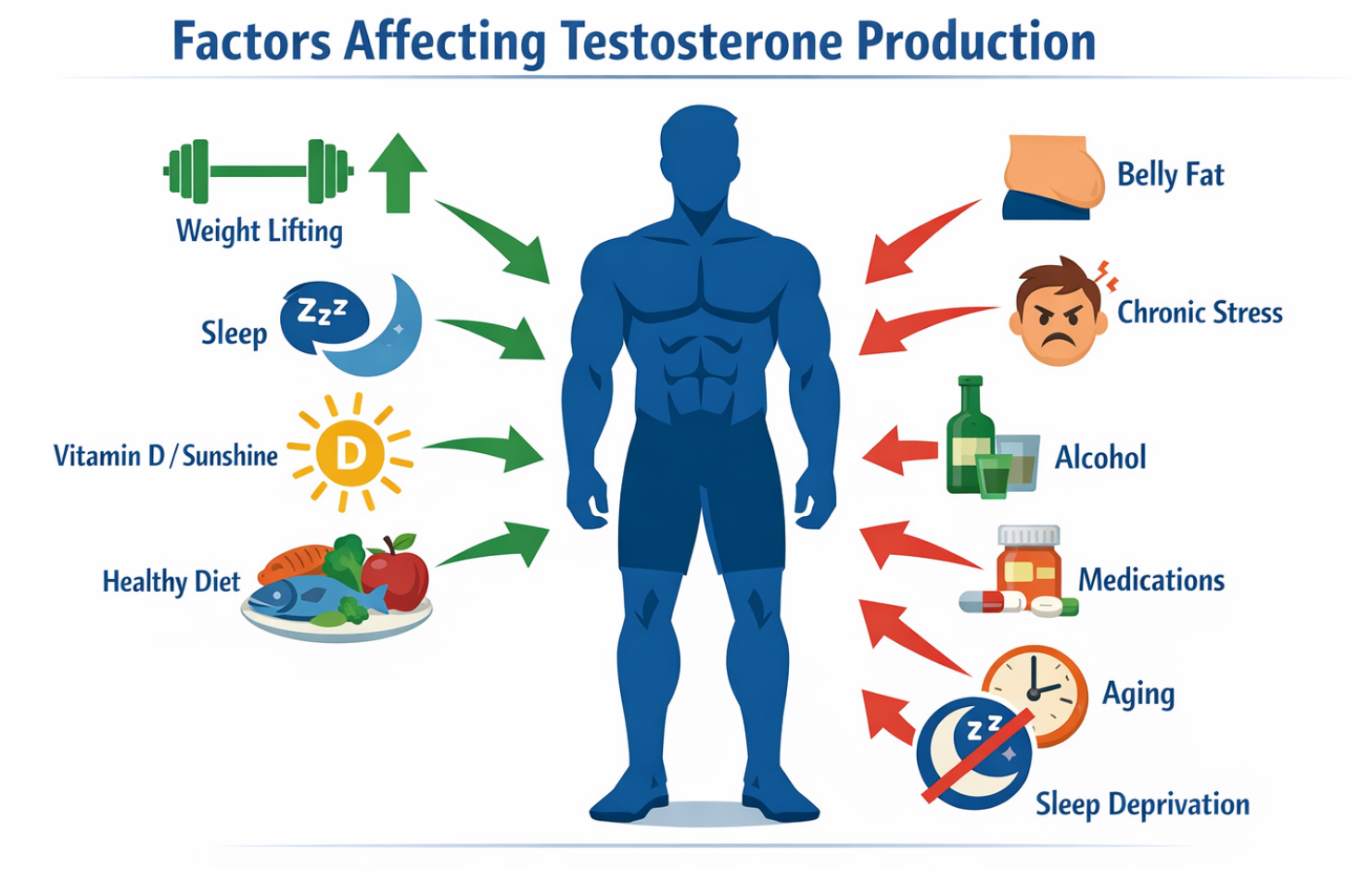
Quick Recap
Major Factors
- Body fat: Both too high and too low are problems
- Sleep: Essential for testosterone production
- Stress: Chronic cortisol suppresses testosterone
- Age: Some decline occurs, but healthy lifestyle may minimize it significantly
Other Considerations
- Vitamin D deficiency
- Medications (especially opioids)
- Medical conditions (diabetes, sleep apnea)
- Extreme exercise (under-training or over-training)
- Alcohol excess
The Reality
- Some factors are within your control
- Some men need TRT regardless of lifestyle optimization
- Don't let perfect be the enemy of good
- The goal is feeling better, not moral purity
Next up: Introduction to TRT - What is TRT exactly, who is it for, and what should you expect?