
Appearance
Testosterone in Your Blood
Here's where things get a bit more nuanced. When we talk about testosterone levels, we're usually referring to a blood test result. But that single number doesn't tell the whole story.
Not all testosterone in your blood is actually available to do its job. Let's break down why.
The Three States of Testosterone
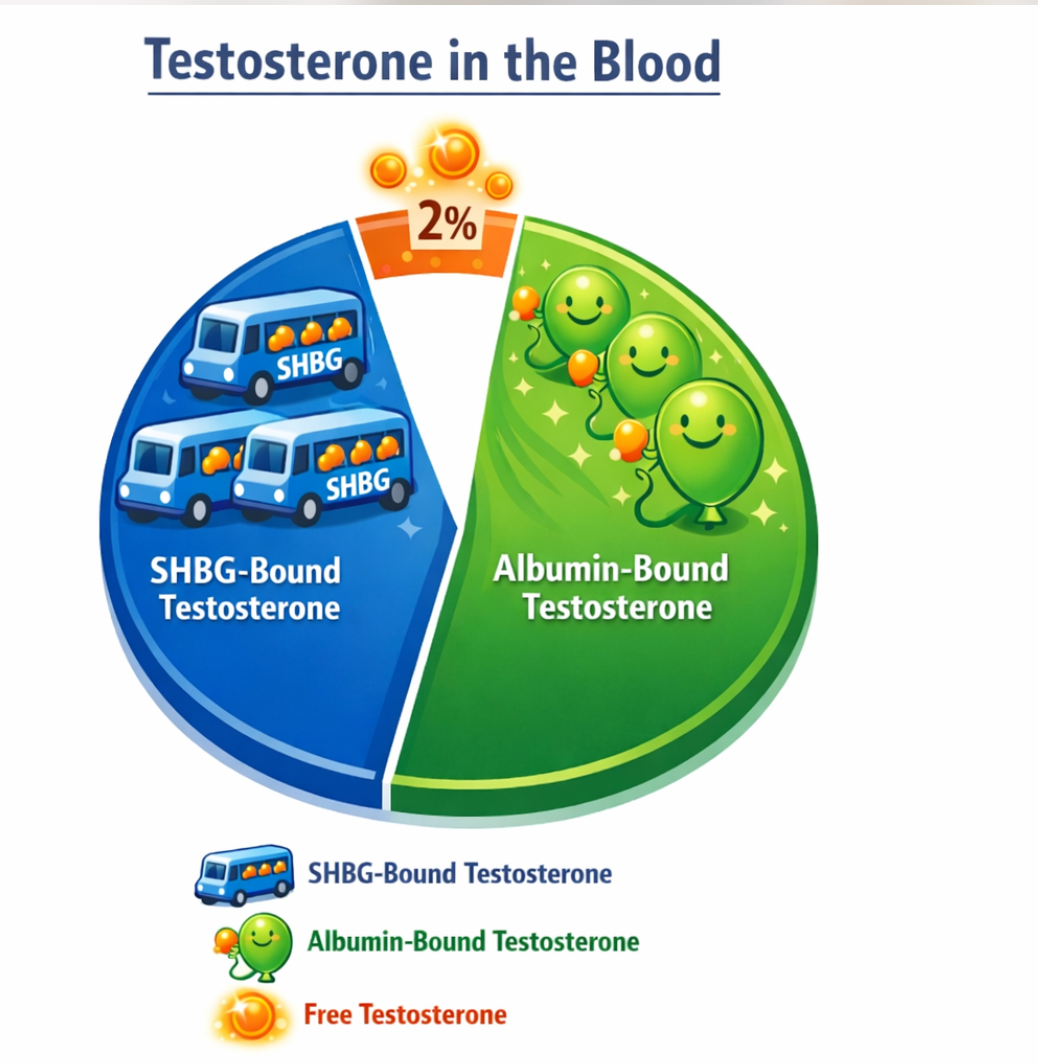
Testosterone in your bloodstream exists in three different forms:
| Type | % of Total | Description |
|---|---|---|
| SHBG-Bound | 30-50% | Tightly bound, mostly unavailable |
| Albumin-Bound | 45-65% | Loosely bound, readily available |
| Free | 1-3% | Unbound and fully available |
These percentages vary significantly between individuals based on SHBG levels, albumin levels, and other factors.
Imagine testosterone molecules as workers trying to get to job sites (your cells).
- Free testosterone: Workers who can walk directly into any job site. Ready to work immediately.
- Albumin-bound: Workers with a loose lanyard clipped to a escort. Easy to unclip when they arrive - they can still work.
- SHBG-bound: Workers in a company shuttle that rarely stops. They're mostly just along for the ride.
SHBG: The Tight Grip
Sex Hormone Binding Globulin (SHBG) is a protein made in your liver. Its job is to bind to sex hormones (testosterone and estrogen) and transport them through your blood.
SHBG binds to testosterone very tightly. Once testosterone is grabbed by SHBG, it's largely unavailable to enter cells and do its job through the normal route.
SHBG has a much stronger affinity for testosterone than albumin does - orders of magnitude higher. When SHBG grabs testosterone, it's not letting go easily.
But is it completely unavailable? The traditional "free hormone hypothesis" says yes - only free testosterone matters. And clinically, this holds up well: men with normal free T but low total T (due to low SHBG) have normal function, while men with normal total T but low free T (due to high SHBG) often have symptoms.
However, research has found a protein called megalin that can pull SHBG-bound testosterone into certain cells. Mice without megalin have reproductive problems. So "completely unavailable" may be an oversimplification - but for practical purposes, free and albumin-bound testosterone are what matter most.
What Affects SHBG Levels?
Several factors can raise or lower your SHBG:
Things that INCREASE SHBG (meaning less free testosterone):
- Aging (though this may be partly due to associated health changes)
- Liver disease
- Hyperthyroidism (overactive thyroid)
- Low caloric intake / eating disorders
- High estrogen levels
- Certain medications
Things that DECREASE SHBG (meaning more free testosterone):
- Obesity
- Insulin resistance / Type 2 diabetes
- Hypothyroidism (underactive thyroid)
- High androgen use
- Some medications
- Acromegaly
Here's an interesting paradox: obese men often have low SHBG, which sounds good because it means more free testosterone, right?
Wrong. Obese men also tend to have lower total testosterone production. So even though their SHBG is low, they often don't have much testosterone to free up in the first place. It's like having loose handcuffs but very few workers.
The Problem with Very Low SHBG
You might think: "Great, I want really low SHBG so all my testosterone is free!"
Not so fast.
Very low SHBG (single digits) is often a red flag, not a blessing.
Single-digit SHBG typically indicates an underlying metabolic problem, most commonly:
- Insulin resistance
- Pre-diabetes or Type 2 diabetes
- Metabolic syndrome
- Non-alcoholic fatty liver disease (NAFLD)
If your SHBG is in the single digits, don't celebrate - get your metabolic health checked.
There's another practical problem with very low SHBG: your hormone levels become more unstable.
SHBG acts like a reservoir or buffer. It holds onto testosterone and releases it slowly, keeping your levels relatively stable throughout the day.
Without that buffer (with very low SHBG), your testosterone levels can swing wildly. You might feel great for a few hours after an injection, then crash hard. It's like the difference between sipping water throughout the day versus chugging it all at once and then being thirsty later.
Albumin: The Friendly Carrier
Albumin is the most abundant protein in your blood. It carries all sorts of things - not just hormones - throughout your body.
Unlike SHBG, albumin binds to testosterone loosely. This matters because:
- The bond can easily be broken when testosterone reaches target tissues
- Albumin-bound testosterone is considered "bioavailable" - potentially usable
The term "bioavailable testosterone" typically refers to free testosterone PLUS albumin-bound testosterone. This represents all the testosterone that could potentially act on your tissues.
Bioavailable T = Free T + Albumin-bound T ≈ 50-70% of total testosterone (varies by individual)
Total Testosterone vs. Free Testosterone
Now you can see why just looking at Total Testosterone doesn't give you the complete picture.
Total Testosterone = All testosterone in your blood (free + albumin-bound + SHBG-bound)
Free Testosterone = Only the completely unbound testosterone (1-3%)
Two guys could have identical total testosterone of 600 ng/dL, but if one has very high SHBG and the other has low SHBG, their free testosterone levels will be very different - and they'll likely feel very different.
This is why free testosterone - not total testosterone - should be your primary metric.
When optimizing TRT, you're really optimizing for free testosterone. A guy with high SHBG might need a total testosterone of 1200+ ng/dL to achieve adequate free testosterone levels. A guy with low SHBG might feel great at a total of 500 ng/dL.
Chasing a specific total testosterone number without considering SHBG is missing the point entirely.
Example:
| Person | Total T | SHBG | Free T |
|---|---|---|---|
| Guy A | 600 ng/dL | 70 nmol/L (high) | 8 ng/dL (low) |
| Guy B | 600 ng/dL | 20 nmol/L (low) | 18 ng/dL (high) |
Same total testosterone, but Guy B has more than double the free testosterone. Guy B is likely to feel much better.
The Testing Problem
Direct free testosterone tests are notoriously inaccurate. Most labs use an "analog" method that gives unreliable results.
The solution: Test Total Testosterone + SHBG, then calculate free testosterone using the Vermeulen equation. Online calculators make this easy.
See Chapter 5: Testing Your Testosterone for the full guide on what to test and how to interpret results.
Understanding Your Numbers
Here are rough reference ranges (keep in mind these vary by lab and age):
| Marker | Normal Range | Notes |
|---|---|---|
| Total Testosterone | 300-1000 ng/dL | Wide individual variation |
| Free Testosterone | 9-25 ng/dL | Via calculation, not direct test |
| SHBG | 10-57 nmol/L | Lower in obesity, tends to rise over time |
| Albumin | 3.5-5.0 g/dL | Usually stable unless liver/kidney issues |
Don't get too hung up on where you fall within the "normal" range. How you feel matters more than hitting a specific number. Many healthy older men maintain testosterone levels comparable to younger men.
Context matters. How you feel matters. The numbers are just one piece of the puzzle.
The Estradiol Connection
While we're talking about what's floating around in your blood, let's briefly mention estradiol (the main estrogen in men).
Some of your testosterone gets converted into estradiol by an enzyme called aromatase. This happens mainly in:
- Fat tissue (this is a big one)
- Liver
- Brain
- Bone
- Testes
SHBG also binds to estradiol, though not as tightly as it binds to testosterone. So your SHBG levels affect both hormones.
The testosterone-to-estradiol ratio matters. You need some estradiol - it's crucial for bone health, brain function, and cardiovascular health. But too much relative to testosterone can cause problems.
We'll dive deep into estrogen management in Chapter 12.
Quick Recap
- Only 1-3% of your testosterone is "free" and fully active
- SHBG tightly binds 30-50% of testosterone, making it mostly unavailable
- Albumin loosely binds 45-65%, which is readily available
- These percentages vary between individuals based on SHBG and other factors
- Total T alone doesn't tell the whole story - SHBG matters a lot
- Very low SHBG is usually a sign of metabolic problems
- Direct free testosterone tests are unreliable - calculate it instead
- Get Total T, SHBG, and Albumin tested for the best picture
Next up: The Hormone Control Center - How your brain controls the whole testosterone production system. Understanding this is key to understanding TRT.