
Appearance
How Testosterone Works
So testosterone floats around in your blood. Cool. But how does it actually do anything? How does a molecule in your blood tell your biceps to grow or your brain to feel motivated?
The answer: receptors.
The Lock and Key System
Think of your cells like houses, each with a very specific lock on the door. Testosterone is a key that fits into that lock. When the key (testosterone) fits into the lock (receptor), the door opens and things start happening inside.
No key? Door stays locked. Nothing happens.
This is the fundamental way hormones work throughout your body. They don't directly do anything themselves - they're just messengers that unlock specific doors in your cells.
Androgen Receptors: The Testosterone Locks
The "locks" that testosterone uses are called Androgen Receptors (AR). These receptors are proteins found in cells throughout your body - in your muscles, bones, brain, skin, prostate, fat cells, and many other tissues.
Androgen receptors are specifically designed to recognize and bind to androgens like testosterone and its more powerful cousin, DHT (dihydrotestosterone - more on this bad boy later).
Different tissues have different densities of these receptors, which is why testosterone affects some parts of your body more than others. Your muscles have tons of androgen receptors. Your earlobes? Not so much.
What Happens When Testosterone Binds?
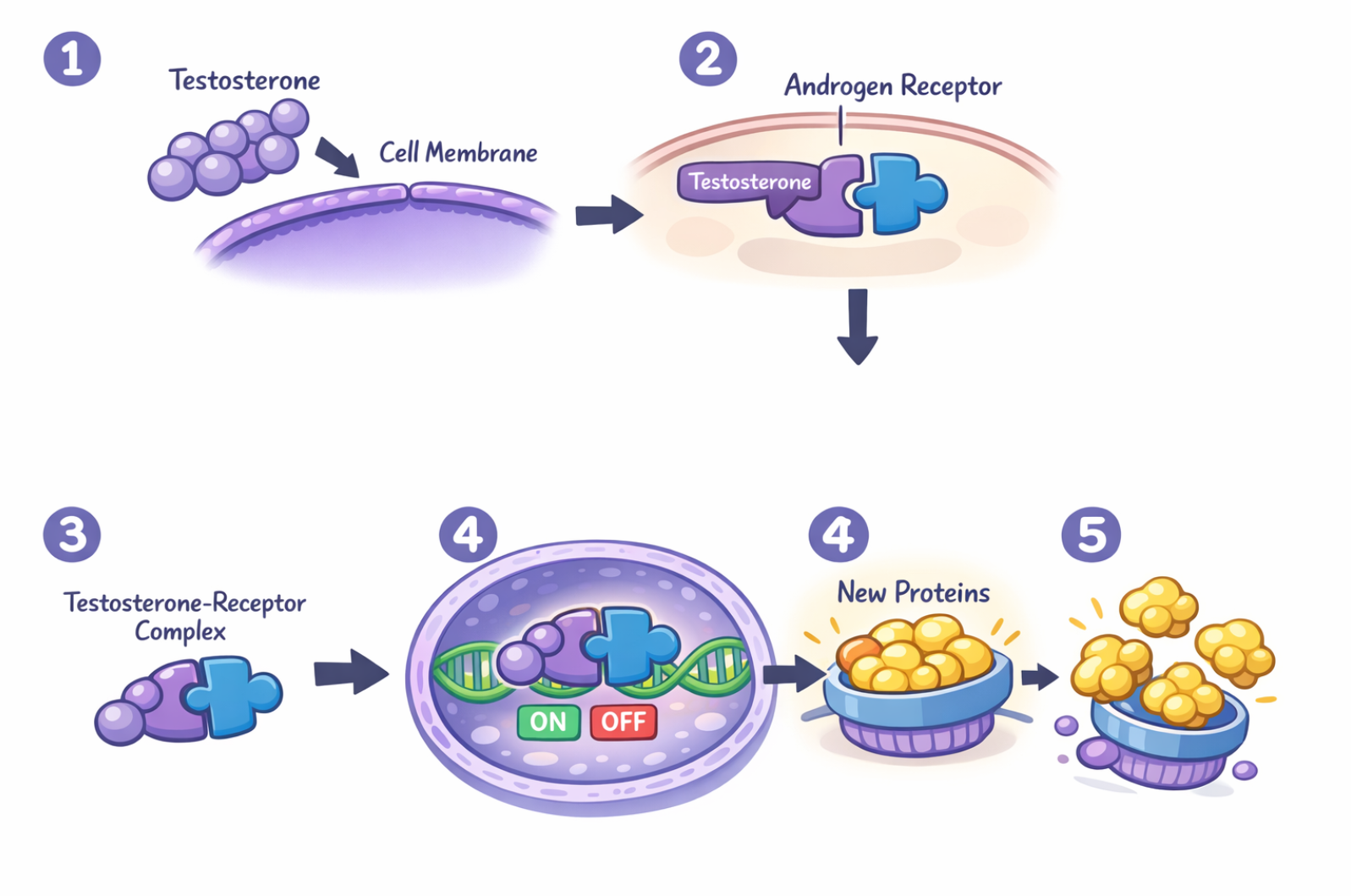
Testosterone enters a cell, binds to an androgen receptor, and the pair travels to the nucleus where it switches specific genes on or off. Those genes then produce proteins that do the actual work - building muscle, strengthening bone, or whatever that cell is designed to do.
The Sensitivity Factor
Here's something crucial to understand: not everyone's receptors are equally sensitive.
Some guys have androgen receptors that are extremely responsive to testosterone - even relatively low levels can trigger a strong response. Others have receptors that are less sensitive and need more testosterone to achieve the same effect.
This explains why two guys with the same testosterone levels can have completely different experiences. One might feel great at 500 ng/dL while another might have low-T symptoms at the same level. It's not just about how much testosterone you have - it's about how well your cells respond to it.
Unfortunately, there's no easy way to test receptor sensitivity. It's mostly something you figure out based on how you feel and respond to different testosterone levels.
Meet Testosterone's Bigger Brother: DHT
Testosterone isn't the only key that fits into androgen receptors. There's another player that's actually 3-5 times more powerful at activating these receptors: Dihydrotestosterone (DHT).
Your body converts some testosterone into DHT using an enzyme called 5-alpha reductase. This happens mainly in:
- Skin
- Prostate
- Hair follicles (scalp and body)
DHT is like testosterone's stronger, more focused brother. It binds more tightly to androgen receptors and doesn't let go as easily. This makes it more powerful in tissues where it's produced.
The catch? DHT is responsible for both good things (genital development, body hair) and not-so-good things (prostate enlargement, male pattern baldness in genetically susceptible guys).
The Hair Loss Connection
This is where genetics really come into play. If you're genetically predisposed to male pattern baldness, DHT binding to receptors in your scalp hair follicles gradually miniaturizes them, leading to thinner and eventually absent hair.
Some guys are terrified that TRT will make them go bald. Here's the reality: if you're genetically programmed for hair loss, you're probably going to lose it eventually regardless. TRT might speed up the process somewhat, but it's not the root cause - your genetics are.
If you're not genetically prone to baldness, higher testosterone/DHT levels won't suddenly make you bald. The follicles need to be sensitive to DHT in the first place.
Summary: The Receptor Dance
Let's bring it all together:
- Testosterone is just a messenger - it doesn't do anything on its own
- Androgen receptors are the real workers - they receive the message and trigger action
- Different tissues have different receptor densities - explaining why testosterone affects some areas more than others
- Receptor sensitivity varies between individuals - same testosterone levels can mean different experiences
- Effects take time - this is a gene-activation process, not flipping a light switch
- DHT is testosterone's more powerful cousin - important for some effects, problematic for others
Does "more testosterone = more gains" work forever? Actually, research shows muscle growth continues to be dose-dependent even at supraphysiological levels - your receptors don't simply "fill up." Higher testosterone can even upregulate androgen receptors and stimulate satellite cell proliferation (adding new nuclei to muscle fibers).
So why isn't "more is better" the answer for TRT? Because TRT isn't about maximizing muscle - it's about restoring health. Supraphysiological doses come with real costs: cardiovascular strain, hormonal disruption, and other side effects. The goal of TRT is optimal health and function, not maximum testosterone.
Next up: Testosterone in Your Blood - Not all testosterone in your blood is actually available to your cells. Let's talk about total vs. free testosterone, SHBG, and why it matters.